The Structure of Choice
Most strategy frameworks focus on execution: better products, lower costs, or improved processes. Spatial Choice Theory reframes strategy as a problem of positioning in the real-world choice space.

Or Why Competition Is Spatial Before It Is Operational
Rethinking Strategy
Most strategy work begins in the middle. You are given a product, a market, and an implicit constraint: the problem is to make what already exists better, cheaper, or more widely distributed. That framing is so common it is rarely questioned.
But for most who have been working in executive roles or venture building, that framing often proves to be a useful as a starting point—effective at refining a given product or market, but less helpful in explaining why some well-executed strategies never materialize into durable advantage.
That missing question is the starting point for what I call Spatial Choice Theory.
The core observation is straightforward but underappreciated: people do not choose among all possible options. They choose among the options that are accessible, acceptable, and relevant in a specific moment. Competition, then, is not primarily about products in the abstract, but about where those products sit within a bounded, situational “choice space.”
In this framework, the true unit of competition is not the product itself, but its configuration across five dimensions: Cost, Access, Effort, Fit, and Perceived Risk. Together, these define a position in choice space. That position determines not just whether a product can win, but when it can plausibly be chosen at all. Strategy, accordingly, is less about relentless improvement and more about deliberate positioning: deciding which parts of the space to occupy, which to ignore, and—occasionally—how to reshape the space entirely.
This stands in contrast to how modern strategy is typically taught and practiced. The standard model begins with customer preferences: discover what users want, design a product to satisfy those wants, and compete by improving quality, adding features, or lowering prices. Advantage is linear and cumulative. Understand the customer better than competitors, execute more effectively, and success should follow.
Embedded in this view is a critical assumption: that markets are relatively stable. Preferences are legible, durable, and broadly shared. Once identified, they can be served through better products and better execution. Competition, in other words, becomes an optimization problem. Firms win by doing essentially the same things as their rivals—only more efficiently.
For a time, this appeared to be correct. Digital technology reduced costs, expanded access, improved coordination, and made customer data easier to collect and analyze. If competitive advantage were primarily operational, digital transformation should have produced clearer winners and more durable leaders.
Instead, the opposite often occurred. Thoughtfully designed products struggled to scale. Startups that cracked pricing or distribution failed to sustain momentum. Incumbents with world-class supply chains faced persistent margin pressure. Even as software reduced friction, real-world constraints—proximity, trust, timing—proved remarkably resistant to abstraction. People still shop at grocery stores. They still visit doctors. They still make decisions within physical, temporal, and social limits.
The issue is not that preferences do not matter. They do. But they are insufficient. Choice is constrained by availability, effort, context, and circumstance. Consumers do not select from the universe of possible options; they choose from the small subset that shows up as viable in a given moment.
Spatial Choice Theory formalizes this reality. It starts from the premise that the structure surrounding a decision—the choice environment itself—often matters more than the preference expressed within it. Firms compete first for positions in the space of real-world choices, and only then on execution within those positions. Execution remains necessary, but it is not sufficient. Without the right position, even flawless execution struggles to produce durable advantage.
Execution Versus Position
Strategy discussions tend to gravitate toward execution. Improve outcomes, lower costs, reduce friction, expand access—these are concrete, legible levers, and they lend themselves to measurement and management. The risk is not that these efforts are misguided, but that they crowd out a more basic question: which positions are actually worth executing against in the first place?
Execution governs how well a firm performs within a given position. It does not determine whether that position is attractive, defensible, or even visible to customers at the moment of choice. The distinction is easy to overlook precisely because execution is observable. Firms can chart efficiency gains, cost curves, and performance improvements with increasing precision. What is far harder to see is positional crowding: the degree to which multiple competitors are converging on the same configuration and competing for the same limited set of real-world choices.
When several firms occupy effectively the same position, improvements are competed away and passed through to customers. From the outside, these markets appear intensely competitive; from the inside, firms find themselves expending more effort simply to maintain their place. Margin pressure and strategic instability, in this view, are not failures of execution so much as indicators of crowding—signals that the position itself has become over-contested.
Choice Is Contextual
Consumers do not rely on a single, stable decision-making framework across all situations. How someone chooses what to eat, where to seek care, or how to move through a city varies with urgency, location, energy, risk tolerance, and the options that happen to be available. The same individual may prioritize quality in one moment, convenience in the next, and cost shortly thereafter—sometimes within the span of a single day.
These shifts are not inconsistencies; they are rational responses to constraint. Time pressure, proximity, availability, and cognitive load shape what feels like a reasonable choice in any given moment. A parent selecting a pediatrician during an emergency is solving a fundamentally different problem than one evaluating long-term care. A commuter grabbing lunch between meetings is not optimizing for the same criteria as someone planning a weekend meal.
Preferences exist in the abstract, but choices are made in context. It is the context—the person, the moment, the environment, and the set of visible options—that defines the local space of viable choices.
Firms, however, often behave as if choice were context-free. Products are designed for an idealized decision-maker: calm, deliberate, and consistently preference-driven. Strategy documents, in turn, treat value propositions as broadly applicable, with variability acknowledged conceptually but rarely incorporated into design or positioning.
The result is a familiar pattern. Offerings improve along objective dimensions, yet consumer behavior changes less than models predict. Market share shifts are modest. Loyalty proves fragile. Advantage erodes even as execution improves. What is missing is positional framing: competition is not only about what is offered, but about when, where, and how that offering enters real-world moments of choice.
Three Modes of Resolution
Consider a familiar decision: where to get lunch.
- Some days, performance dominates: the consumer seeks the best outcome—taste, nutrition, or quality.
- Other days, convenience dominates: the nearest or fastest option wins.
- On yet other days, value dominates: the option that clears a minimum standard at the lowest cost is selected.
The same individual, with the same underlying preferences, resolves decisions differently depending on context. A patient managing a chronic condition may travel farther for expertise, but for an urgent minor issue chooses the closest provider. A fitness enthusiast may invest in coaching during periods of motivation, then revert to simpler routines when time or energy is constrained.
These are not customer segments. They are resolution modes, determined by situational constraints, not intrinsic preferences.
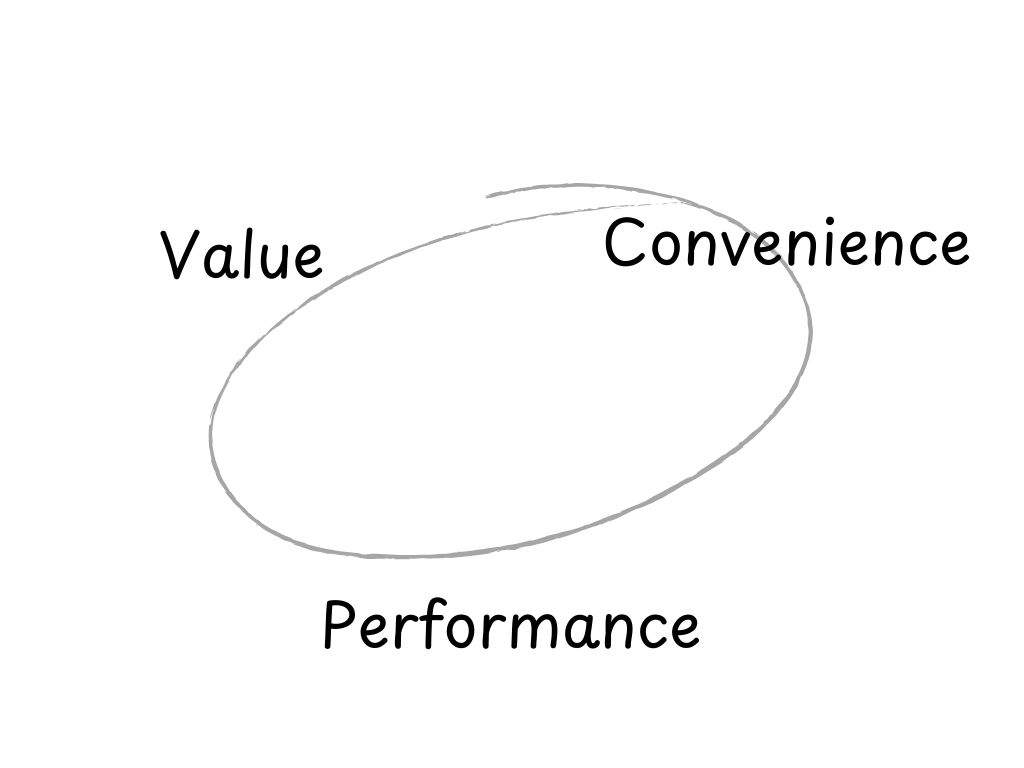
The strategic implication: competition is not a single, unified contest. It unfolds across multiple contexts, each governed by a different logic of selection. Firms that ignore this risk spreading themselves too thin—optimizing broadly, differentiating narrowly, and ultimately competing everywhere but winning nowhere.
Viewed this way, a simple framework emerges: every moment of choice is a localized contest, and every offering occupies a configuration of dimensions that determines which moments it can plausibly win. Strategy is not only about execution—it is about selecting and defending positions in the space of choice.
Competing in Moments of Choice
If consumer choice depends on context, firms are not competing on abstract attributes like “quality” or “value.” They are competing to be available, acceptable, and credible in the moments that matter.
An offering’s position is defined by its configuration across five dimensions:
- Cost – the economic threshold a consumer must cross
- Access – availability at the moment of decision
- Effort – friction required to evaluate, adopt, or switch
- Fit – how directly the offering solves the consumer’s problem
- Perceived Risk – the downside associated with choosing it
Each configuration defines where a product can realistically compete. Firms don’t control how consumers resolve choice—they control how their offerings are positioned across these dimensions.
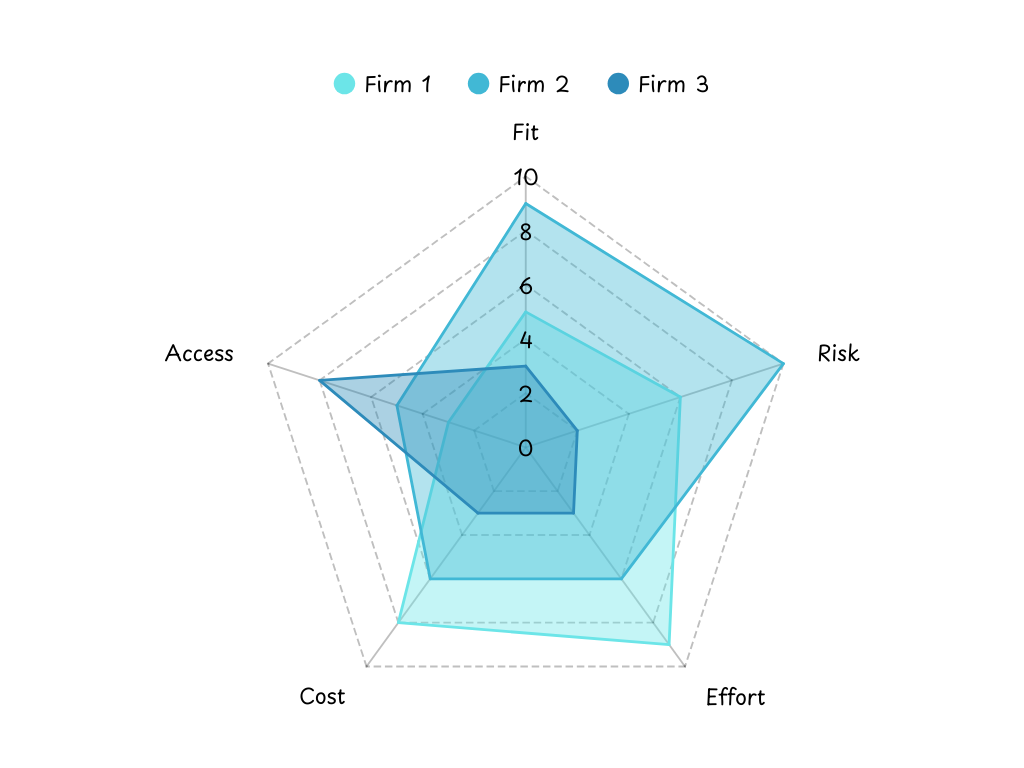
These dimensions interact. Lowering cost may constrain fit. Expanding access can increase effort or perceived risk. Optimizing for one context can raise cost or limit scale. Every offering is a trade-off, whether intentional or not.
Competition intensifies when multiple firms occupy the same configuration. Markets—especially digital ones—push offerings toward similar positions: lower prices, broader access, less friction. Digital tools accelerate convergence, crowding products into overlapping spots.
The result:
- Gains are competed away
- Improvements accrue to consumers, not firms
- Markets appear hyper-competitive even as offerings improve
Margin pressure, churn, and instability are symptoms of positional crowding, not execution failures. Execution matters—but only within a position. Strategy decides whether that position is defensible.
Distribution and Flattened Choice
The internet transformed distribution. For digital goods and standardized services, the marginal cost of reaching an additional user collapsed toward zero. Access expanded, effort declined, and scale became easier than ever.
Ben Thompson’s Aggregation Theory captures what happens in this world: platforms that reduce friction and become default intermediaries naturally capture disproportionate value. Aggregation describes why controlling distribution matters when the choice space flattens.
Spatial Choice Theory frames this as a special case of positional competition. When access is global, effort minimal, and marginal cost near zero, most constraints dissolve. Configurations that differ along cost, fit, or risk converge into a narrow set of viable positions. Control of distribution matters here because it shapes the choice environment itself.
Think of a smartphone home screen, a default search engine, or a leading social network. When access is near-universal and effort negligible, the options consumers actually consider shrink. Competition concentrates at these flattened points, and positional advantage accrues to whoever occupies them.
The insight is broader than aggregation. Spatial Choice Theory explains both why aggregation dominates in flattened contexts and why the same logic does not generalize to markets where trust, fit, risk, or proximity are decisive.
Seeing Competition Spatially
Spatial Choice Theory reframes the core question: what are firms actually competing over? The battleground is the configuration of an offering across Cost, Access, Effort, Fit, and Perceived Risk. These positions determine which moments of choice a firm can win—and which it cannot.
Execution matters—but only within a position. Perfect execution cannot compensate for an unviable configuration. When multiple offerings converge, gains are competed away. Hyper-competitive markets, margin pressure, and churn are signs of crowding, not execution failure.
Some contexts are dominated by distribution—access and effort are compressed, as in digital platforms. Others are dominated by fit, trust, risk, or proximity, where operational excellence within crowded positions yields only marginal advantage. Spatial Choice Theory covers both: aggregation is a special case, not a universal law.
The strategic takeaway is clear: stop asking, “How can we be better?” Start asking, “Where can we be different?”
· Position defines opportunity
· Execution unlocks value within it
Firms that understand this early can design offerings that align with specific moments of choice, avoid crowding, and create durable advantage. Firms that do not will execute brilliantly—only to find the space they compete in is already full.
Strategy is no longer just products, features, or operational excellence. It is spatial positioning in the landscape of real-world choice. Firms that master this view can anticipate competitive dynamics, predict where advantage will emerge, and see where it will vanish.
Spatial Choice Theory is not just a lens—it is a framework for action: to decide deliberately and unapologetically where to compete, and where not to compete.