Inside the Greenhouse
Greenhouse tomato production has become extraordinarily sophisticated, but its output still depends on adaptive human labor. Imitation learning may change not only how tomatoes are harvested, but how growers obtain, deploy, and pay for productive capability.
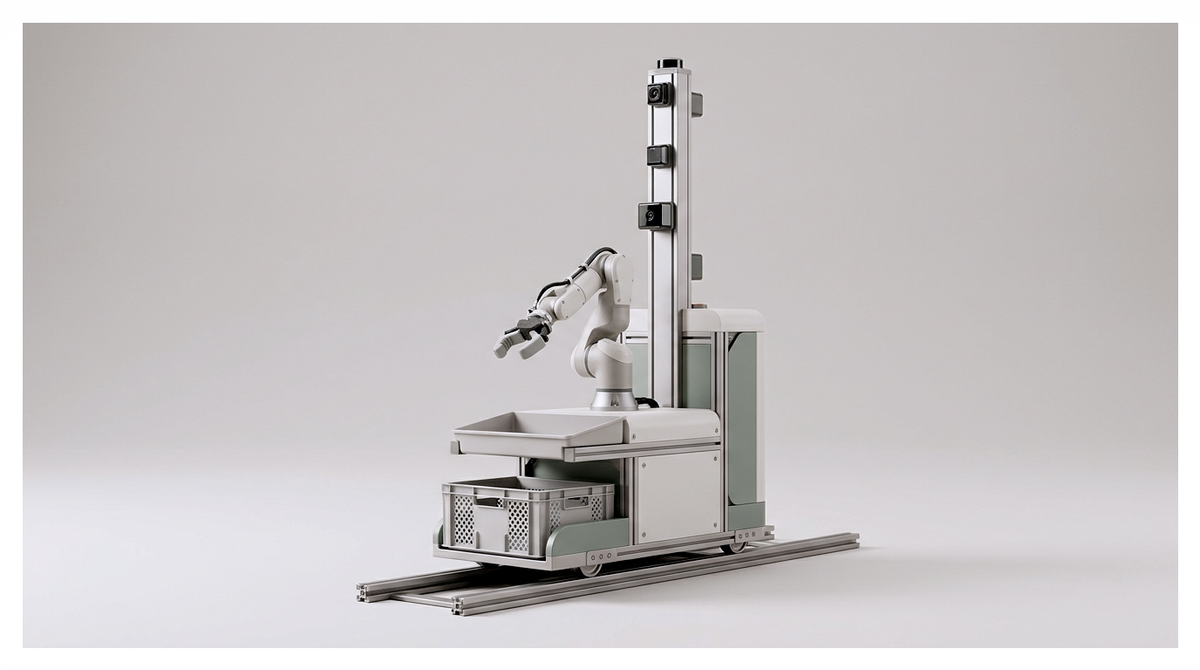
Greenhouse tomato production has solved many old problems. Its next constraint may be adaptive labor—and imitation learning may change how growers obtain it.
A modern greenhouse is an extraordinary piece of production infrastructure. It allows a grower to manage temperature, humidity, light, irrigation, nutrients, and carbon dioxide. It reduces exposure to weather. It can extend the growing season. In colder climates, it makes fresh tomatoes possible in months when open-field production is not.
In many respects, the greenhouse has already turned tomato growing into a form of advanced manufacturing. The crop is still biological, but much of its environment has been engineered.
Yet one input has not become nearly as manageable: the person who harvests it.
A worker picking tomatoes performs a task that looks repetitive but is not. They move through foliage, judge ripeness, locate a stem, choose an approach, cut or detach fruit, and avoid damaging the plant. The action repeats. The conditions do not. Leaves shift. Fruit hides. Stems sit at awkward angles. The correct movement changes from one tomato to the next.
That is why Polybot, a Tübingen-based agricultural robotics company, is a useful place to begin. Polybot is developing a tomato-harvesting robotthat learns from human demonstrations rather than relying only on explicitly programmed rules. The project received support from Germany’s Federal Agency for Breakthrough Innovation, SPRIND, including an initial validation contract of about €220,000 beginning in February 2025 and later support for company formation.
The question is not whether Polybot will succeed. It is too early to know that. The question is what it would mean if robots could acquire this kind of adaptive physical skill reliably enough to operate in commercial greenhouses.
The answer may be more consequential than “robots replace pickers.” It may be that greenhouse operators gain a new way to obtain, schedule, and pay for productive capability.
A worker picking tomatoes performs a task that looks repetitive but is not.
The Market Is Not Short Of Ambition
Tomatoes are central to European food consumption. The European Commission maintains detailed market data on fresh tomato production, prices, and trade, reflecting the crop’s economic importance across the EU.
The structure of supply is changing. Recent market reporting points to declining fresh tomato production in European winters, continued demand for fresh tomatoes, and rising imports, with Morocco identified as a major supplier. One industry forecast expects average annual fresh tomato consumption to remain around 15.2 kilograms per person, while EU imports are projected to continue rising modestly and exports to decline.
That combination deserves attention. It does not prove that Europe faces a permanent tomato shortage. Weather, energy costs, disease, trade conditions, and grower economics can all shift supply from year to year. But it does suggest a persistent tension: demand for fresh tomatoes remains substantial, while European production capacity is under pressure.
The pressure is especially visible in protected cultivation. Greenhouse production can deliver high yields and year-round supply, but it requires significant capital: structures, climate systems, lighting, irrigation, monitoring, and skilled operational management. The Netherlands illustrates the model. It accounts for a small share of EU tomato-growing area but produces a disproportionate share of output, reflecting the productivity of its greenhouse systems.
In other words, Europe does not lack the ability to grow tomatoes intensively. It has some of the world’s most advanced systems for doing so.
The question is whether it can operate them at the required scale, cost, and reliability.
The missing input is not “labor”
It is tempting to describe the problem as a labor shortage. In some places and seasons, it is. But that phrase hides more than it reveals.
A greenhouse operator does not simply need more people. It needs people who can recognize the state of the crop, decide what action is appropriate, perform it to standard, and do so consistently across a large facility. Harvesting is not the only example. Crop maintenance, pruning, training, scouting, and quality control all involve judgment applied to living material.
These capabilities are partly tacit. They are learned through repetition and feedback. They are difficult to specify completely in advance. And they become scarce exactly when they matter most: during harvest windows, when fruit is ready and delaying action has a cost.
When adaptive labor is unavailable, the consequences are not limited to higher wages.
A grower may harvest later than ideal. Fruit may be left on the plant too long. Quality may become inconsistent. Supervision costs may rise. A facility designed for continuous production may operate below its intended capacity. In a market where supply is already tight, those effects can compound.
So the binding constraint is better described as access to dependable adaptive capability: the ability to perceive a situation, choose an action, execute it well, and repeat it at commercial scale.
That is a different problem from finding cheaper hands.
Why harvesting is hard to automate
Traditional automation works best when the task and environment can be specified in advance. Engineers define the relevant states of the world, program the required responses, and build equipment that repeats the procedure.
That approach becomes brittle when the correct action depends on variation that is hard to enumerate. A tomato may be ripe but obstructed. A stem may be positioned awkwardly. The right movement may depend on small differences in geometry, lighting, plant condition, or the position of nearby fruit.
Imitation learning offers another route. Instead of trying to write every rule, the system learns from examples of people doing the work. Demonstrations provide information about the relationship between what the robot observes and the action it should take.
Polybot describes its approach as learning harvesting end to end from human motion. SPRIND says the team shows the robot the movement rather than describing the tomato or telling it how to reach for it. The idea is that repeated demonstrations help the system infer which features matter and which actions are appropriate.
The appeal is straightforward. Experienced workers already possess knowledge that is difficult to turn into instructions. If a robot can learn from their behavior, some of the engineering burden of anticipating every situation may be reduced.
But a demonstration is not yet a business.
A successful demonstration says that the system can perform a task under particular conditions. It does not establish that the learned behavior will transfer to another greenhouse, another variety, another lighting environment, or another season. It does not establish commercial reliability, acceptable crop damage, maintenance requirements, or attractive unit economics.
The distance from “the robot picked tomatoes” to “the robot changed the grower’s cost structure” is long.
What has to be true
For imitation learning to matter commercially, several things have to be true at once.
The robot must work in controlled tests. That is the easy part, relatively speaking.
It must generalize. It must cope with variation across rows, plants, facilities, seasons, and operating conditions without requiring the supplier to redesign the system each time.
It must be reliable. A machine that performs well for an hour but needs frequent intervention is not yet a production asset. A machine that damages fruit, misses harvests, or stops unexpectedly may create costs that outweigh its labor savings.
It must be economical. Not in a laboratory calculation, but after installation, integration, maintenance, supervision, financing, and realistic utilization are included.
And it must be repeatable. A supplier that treats every customer as a bespoke project may build interesting technology without building a scalable business.
This is where many robotics efforts fail. Not because the robot cannot perform the task, but because the supplier cannot reproduce the conditions under which it performs well.
The question is not whether Polybot can pick a tomato. The question is whether it can make a capability dependable enough to sell.
What changes if it works
Suppose imitation learning eventually makes adaptive harvesting dependable in commercial greenhouses. The immediate result would be a new substitute for human labor in a specific task.
The more important result could be a change in how growers obtain productive capability.
Today, that capability usually comes with people. A grower hires workers, trains them, supervises them, schedules them, and manages the inevitable variation in skill and availability. The capability is embedded in a workforce.
A mature imitation-learning system could make some of that capability machine-based. But that does not mean every grower will buy robots. It means the capability could be delivered in different commercial forms.
One possibility is that growers own the machines. They buy or lease robots, integrate them into their operations, and retain the benefits if the systems perform well. This gives them control, but it also gives them capital risk, maintenance risk, and the burden of making the equipment productive.
A robot that works well but sits idle for much of the year may be an expensive way to buy flexibility.
Another possibility is harvesting as a service. A specialist operator owns the fleet and sells harvesting capacity to growers. The grower buys an outcome rather than a machine. The operator handles deployment, maintenance, technicians, and performance.
This model could be attractive if the operator can keep assets busy across customers whose harvest peaks do not coincide. But that is easier said than done. Harvest demand may cluster in the same periods. Moving equipment between sites takes time and money. Different facilities may require different setups. If every deployment requires custom engineering, the service model may become a collection of expensive one-off projects.
A third possibility is a capability platform. The valuable asset would not be the robot itself, but the system that teaches, validates, deploys, and improves machine behavior. Such a platform might combine demonstration data, learning software, validation procedures, operational feedback, and the ability to adapt a system to new tasks or environments.
If learning from one deployment improves the next, the platform could accumulate an advantage. But that depends on whether skills actually transfer, whether data can be reused across customers, and whether the platform retains something customers cannot easily replicate.
We do not know which configuration will win. We may not know for years.
But the important point is that the technology does not determine the business model. The business model determines who benefits from the technology.
The second-order effects
If adaptive harvesting becomes dependable, the first-order effect is lower dependence on human pickers.
The second-order effects are more interesting.
A grower may be able to harvest closer to the optimal moment. That could reduce waste, improve quality, and make better use of the expensive controlled environment already in place. The greenhouse is not merely a building; it is a production asset with high fixed costs. Anything that allows more reliable use of that asset can matter economically.
Labor may also become less of a constraint on expansion. If a grower no longer needs to recruit and train a large seasonal workforce for every additional hectare or every new facility, growth may become less dependent on local labor-market conditions.
The nature of human work may change as well. People may move from repetitive picking toward supervision, maintenance, crop management, quality assurance, and exception handling. That is not automatically better for workers. It depends on training, wages, job design, and whether the new roles are accessible to the people displaced from the old ones.
And the competitive structure of the industry may shift. Growers with standardized facilities, strong operational discipline, and access to automation may gain an advantage over those relying on manual coordination. Suppliers of robots, services, or learning platforms may become more important. Integrators may matter more than expected.
None of this is inevitable. It depends on whether the technology becomes dependable and whether its economics are attractive after all relevant costs are counted.
What the evidence supports
The public evidence supports interest, not yet proven commercial performance.
SPRIND awarded Polybot a seven-month validation contract beginning in February 2025, worth approximately €220,000, to help move the project from research toward a company. After that phase, SPRIND provided a startup grant of almost €1 million that supported Polybot’s founding in November 2025.
Polybot has said it planned a fully integrated pilot in summer 2026 and initial deliveries to growers in early 2027. Reporting on the company says its robot completed its first autonomous tomato pick in May 2025 and was harvesting full greenhouse rows by December 2025.
These are meaningful signals. They suggest that the team is testing the technology in the environment where it must eventually perform, rather than only in a laboratory. They also suggest that SPRIND sees enough promise to fund a transition from research to venture formation.
But none of this establishes the commercial case.
We do not yet have independent evidence on harvest speed, damage rates, downtime, labor requirements, maintenance costs, crop loss, or performance across different growers and greenhouse configurations. Nor do we know whether Polybot’s learning approach will transfer readily beyond vine tomatoes, or whether the company can deploy at a cost and reliability level that growers will accept.
That is not a criticism. It is the normal condition of an early deep-technology venture. The correct response is not to dismiss the signal or inflate it. It is to identify the evidence that would change our judgment.
The question worth asking
For growers, investors, technology companies, and policymakers, the useful question is not “Will robots take over agriculture?” It is:
Under what conditions does imitation learning turn a demonstrated skill into dependable production capacity?
For a greenhouse operator, the question becomes more specific. Where does adaptive labor currently limit output, quality, timing, or expansion? What would it be worth to remove that constraint? And what evidence would justify changing how that capability is sourced?
For a startup, the question is not only whether the robot works. It is whether the company can make the capability transferable, reliable, and economically repeatable across customers.
For policymakers, the question is whether automation can strengthen European food security and reduce dependence on imports without simply displacing workers into lower-quality jobs. The answer will depend on deployment models, labor policy, training, and the design of the systems themselves.
If every greenhouse requires extensive customization, imitation learning may improve robotic capability without changing the economics of deployment. That would still be technological progress. It would not necessarily create a new production architecture.
If, however, demonstrations can be converted into transferable machine skills, and if those skills can be validated and updated across sites, the result may be a new category of productive input: adaptive physical capability that can be owned, rented, or accessed as a service.
A better robot is not yet a different production system
Polybot is strategically interesting because it tests a different way of obtaining adaptive physical capability. If human demonstrations can become dependable machine behavior, growers may gain new options for organizing harvesting, acquiring capacity, and allocating operating risk.
But the opportunity is conditional. It depends on transferability, reliability, economics, repeatability, and value capture. A successful demonstration cannot settle those questions.
The broader lesson is that technologies become strategically consequential when they relax a constraint that limits what businesses can economically do. The opportunity lies not only in the new capability, but in the commercial configurations that become feasible once that capability becomes accessible.
The machine may learn to harvest.
The business opportunity belongs to whoever can turn that skill into dependable production capacity, deliver it economically, and retain a meaningful share of the value created.
Endnote: This memo reflects ATHENSBETA’s interpretation of public information and company disclosures. Early pilots and funding announcements indicate market activity, not independently validated commercial performance. Market-size estimates for greenhouse tomatoes vary by definition and source; the figures cited here should be treated as directional context rather than precise market sizing.